AI Summarization
OpenTranscribe generates AI-powered summaries of your transcripts using Large Language Models (LLMs).
Overview
AI summarization provides:
- BLUF Format: Bottom Line Up Front executive summaries
- Speaker Analysis: Talk time, key contributions by speaker
- Action Items: Extracted with priorities and assignments
- Key Decisions: Important conclusions and agreements
- Follow-up Items: Next steps and pending tasks
Requirements
- LLM provider configured (see LLM Integration)
- Completed transcription with or without speakers
- Sufficient LLM API credits (for cloud providers)
Generating Summaries
From Web UI
- Open the file from the gallery
- Click Generate AI Summary in the file's action row
- Wait for AI processing; the button then reads AI Summary and opens the summary
- To regenerate with a different prompt, choose one in the summary dialog (Use active prompt or one of your prompts) and click Regenerate
AI Summarization Pipeline
Automatic Processing
For long transcripts, OpenTranscribe automatically:
- Splits content into sections at speaker/topic boundaries
- Processes each section independently
- Stitches results into cohesive summary
- Handles transcripts of any length
Summary Formats
BLUF (Default)
Bottom Line Up Front format includes:
Executive Summary:
- 2-3 sentence overview
- Key takeaways
- Critical information first
Speaker Analysis:
- Talk time percentage
- Key contributions
- Speaking patterns
Action Items:
- Task description
- Priority (High/Medium/Low)
- Assigned person (if mentioned)
- Due date (if mentioned)
Key Decisions:
- Important conclusions
- Agreements reached
- Changes approved
Follow-up Items:
- Pending questions
- Future discussions
- Next steps
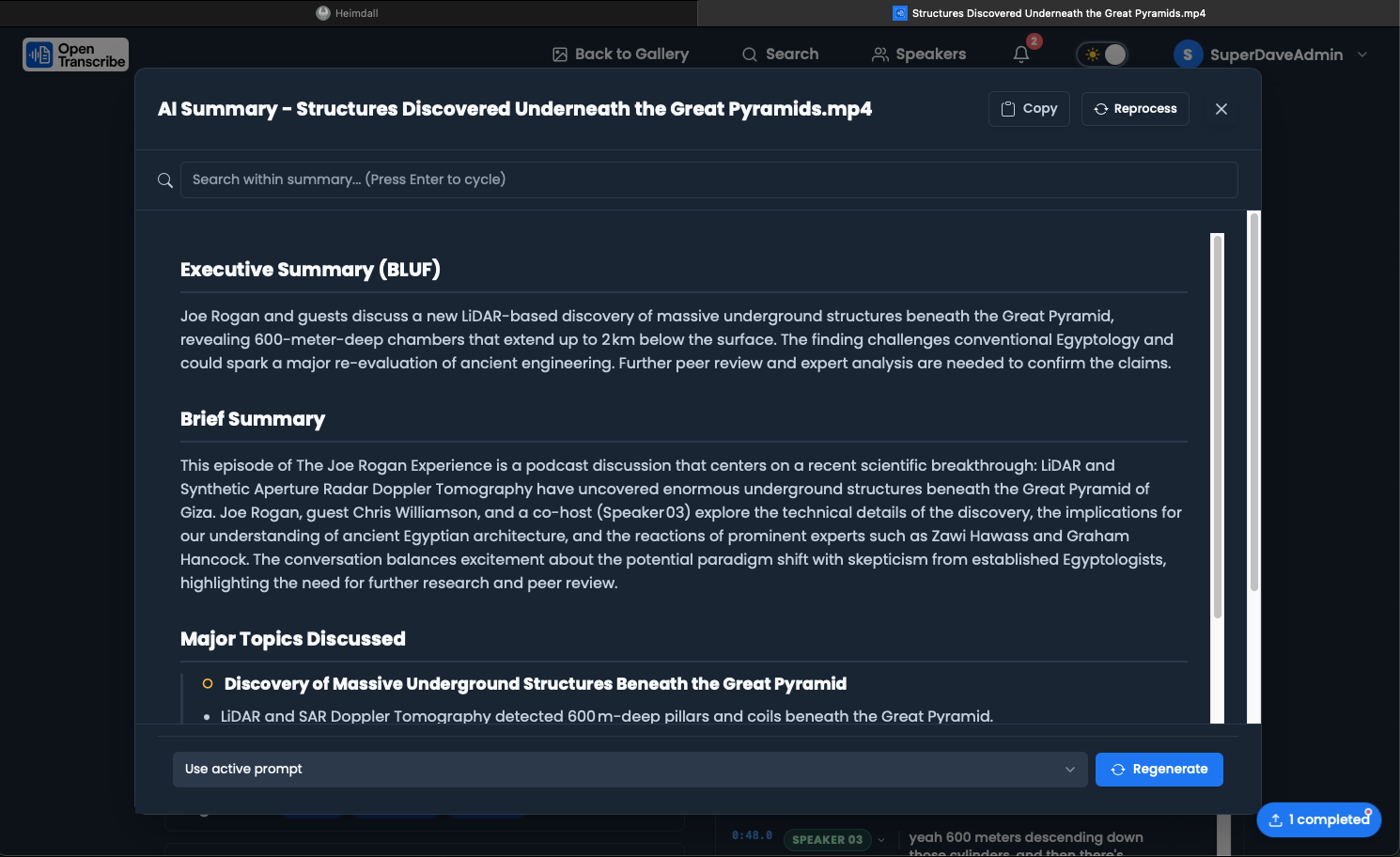
Custom Prompts
Create custom summarization prompts for specific use cases:
- Meeting notes format
- Interview analysis
- Podcast highlights
- Legal deposition summaries
- Medical consultation notes
Organization Context
You can configure organization context (Settings → Organization Context, under AI & Chat) that is automatically injected into AI prompts. This provides the LLM with background information about your organization, improving summary relevance:
- Describe your organization, team structure, or domain
- Choose whether to include context with system prompts (Include with system prompts), your custom prompts (Include with custom prompts), or both
- Up to 10,000 characters of context text
- The context is per user; you can also share yours with all users (Share with all users), and others can adopt a shared one (Use this)
Per-Collection Default Prompts
Collections can have a default AI prompt assigned. When generating a summary for a file in that collection, the collection's default prompt is automatically selected:
- Click Collections in the gallery toolbar
- Create a collection, or click Edit collection on an existing one
- Select a Default Summary Prompt (the default is None (use active prompt))
- Files in the collection will use that prompt by default when generating summaries
This is useful for organizing different types of content (e.g., interviews vs. meetings) that need different summarization approaches.
Disable AI Summary
Automatic AI summarization can be turned off:
- Per-upload: Turn Generate AI summary off on the Options step of the upload dialog to skip summarization for that file
- User default: Go to Settings → LLM Provider Configuration → AI Summary Settings and turn off Auto-generate summaries to skip automatic summarization after every transcription
- System-wide (administrators): System-wide AI summaries in the same place turns summaries off for all users
- When disabled, summaries can still be generated manually by clicking Generate AI Summary on any completed transcript
Auto-Label Pipeline
Auto-Labeling
When an LLM provider is configured, OpenTranscribe can automatically analyze completed transcriptions and suggest organizational labels:
- Auto-tag: AI extracts key topics and applies them as tags
- Auto-collect: AI suggests relevant collections based on content
- Bulk grouping: When uploading multiple files, AI can group them into collections by topic
Configure auto-labeling in Settings → Auto-Labeling (Tags & Collections):
- Enable/disable the feature globally
- Set confidence threshold for suggestions
- Toggle tags and collections independently
- Run retroactively on existing files
LLM Providers
Local LLM (Privacy-First)
Best for sensitive content:
Add a configuration under Settings → LLM Provider Configuration (provider vLLM, Ollama or Custom, with the server's base URL). The .env variables below are only a fallback; a configuration saved in the UI wins.
# vLLM or Ollama (fallback defaults in .env)
LLM_PROVIDER=vllm
VLLM_BASE_URL=http://localhost:8012/v1
Advantages:
- Complete privacy
- No API costs
- Works offline
- Unlimited usage
Requirements:
- Dedicated GPU (8GB+ VRAM)
- Model deployment (Llama, Mistral, etc.)
Cloud LLM
Best for convenience:
# OpenAI (fallback defaults in .env; the UI configuration wins)
LLM_PROVIDER=openai
OPENAI_API_KEY=sk-xxxxx

# Anthropic Claude
LLM_PROVIDER=anthropic
ANTHROPIC_API_KEY=sk-ant-xxxxx
Advantages:
- No infrastructure needed
- Latest models
- High quality results
Considerations:
- Requires internet
- Per-token costs
- Data sent to provider
Performance
| Transcript Length | Processing Time (Cloud LLM) | Processing Time (Local LLM) |
|---|---|---|
| 30 minutes | 10-15 seconds | 20-40 seconds |
| 1 hour | 20-30 seconds | 40-80 seconds |
| 3 hours | 60-90 seconds | 2-4 minutes |
Note: OpenTranscribe intelligently chunks long transcripts, so a 10-hour transcript takes only marginally longer than a 3-hour one.
Configuration
Provider Settings
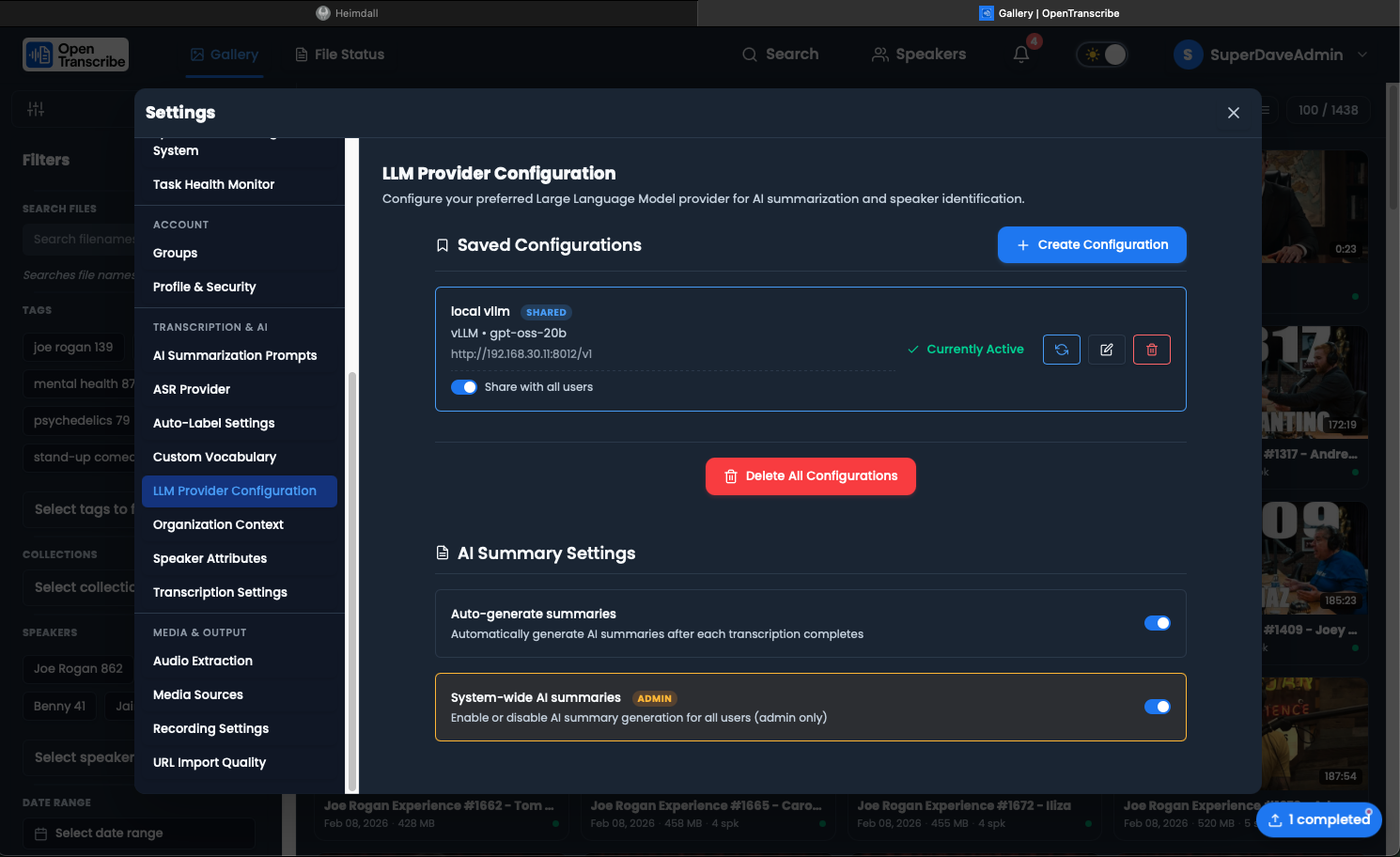
Configure providers in Settings → LLM Provider Configuration (Create Configuration, then Activate). Defaults for a deployment can also be set in .env; a configuration saved in the UI takes precedence:
# Provider selection
LLM_PROVIDER=vllm  # or: openai, anthropic, ollama, openrouter

# Provider-specific
VLLM_BASE_URL=http://localhost:8012/v1
VLLM_MODEL_NAME=meta-llama/Llama-2-70b-chat-hf
OPENAI_API_KEY=sk-xxxxx
ANTHROPIC_API_KEY=sk-ant-xxxxx
Custom Prompts
Create custom prompts in UI:
- Go to Settings → AI Summarization Prompts
- Click Create Prompt
- Configure:
- Prompt Name
- Content Type (General, Meeting, Interview, Podcast, Documentary or Speaker Identification)
- Description
- Prompt Text (use the
{transcript}and{speaker_data}placeholders)
- Save
Use custom prompts:
- Click Activate on a prompt to make it the one used for new summaries, or
- Open a file's summary, choose the prompt, and click Regenerate
A prompt can be shared with all users (Share with all users); others see it under Shared by Others.
Best Practices
- Review AI Summaries: Always verify critical information
- Speaker Labels Help: Labeled speakers produce better summaries
- Clear Audio: Better transcription = better summaries
- Choose Right Provider: Local for privacy, Cloud for quality
- Custom Prompts: Tailor summaries to your workflow
Troubleshooting
Summary Generation Fails
Check:
- LLM provider configured correctly
- API key valid (for cloud)
- LLM server running (for local)
- Sufficient credits (for cloud)
Solution:
# Test LLM connection
./opentr.sh logs celery-worker | grep -i llm
Also check that a configuration under Settings → LLM Provider Configuration is active (Currently Active) and passes Test Connection.
Poor Quality Summaries
Causes:
- Weak LLM model
- Poor transcription quality
- Insufficient context
Solutions:
- Use larger model (70B+ parameters recommended)
- Improve transcription (use
large-v3Whisper model for maximum accuracy) - Add speaker labels for better context
Slow Processing
Solutions:
- Use cloud LLM (faster)
- Upgrade local LLM hardware
- Use smaller model (trade-off with quality)
Cost Estimates (Cloud)
Approximate costs for cloud LLM providers:
| Transcript Length | OpenAI GPT-4 | Claude Opus | OpenRouter |
|---|---|---|---|
| 30 minutes | $0.20-0.40 | $0.25-0.50 | $0.15-0.30 |
| 1 hour | $0.40-0.80 | $0.50-1.00 | $0.30-0.60 |
| 3 hours | $1.20-2.40 | $1.50-3.00 | $0.90-1.80 |
Note: Local LLM has zero per-use cost after hardware investment.